


Beyond its logistical and marketing roles, packaging is subject to specific regulations and obligations. Although these rules may sometimes seem restrictive, they play a crucial role in preventing various issues. By ensuring the safety of goods, individuals, and the environment, product labelling aims to fully protect the consumer.
What is labelling on packaging?
The product label includes the information printed on the packaging, providing comprehensive details about the product. This encompasses the product’s characteristics as well as identification information, such as packaging materials and recycling codes. Labelling is the responsibility of the company in charge of marketing the product.
Why label a product?
In France and throughout the European Union, food product labelling is subject to strict rules. According to Regulation (EU) No 1169/2011, foodstuffs, whether pre-packaged or not, must comply with clear and precise labelling.
Far more than a mere formality, food product labelling plays an essential role in consumer protection. It indeed allows the consumer to be informed and enables them to purchase a product with full knowledge.
Mandatory information on packaging
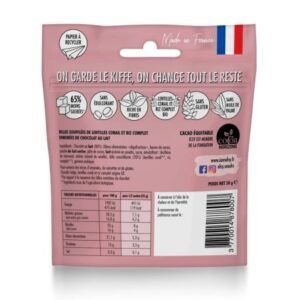
The information to be displayed on the label of food packaging bags is extensive. Here are some of the mandatory mentions to be displayed on pre-packaged products such as bags of chocolate sweets, bags of crisps, or bags of coffee.
- The sales name that defines the product (for example: green mate infusion).
- The list of ingredients in descending order of weight (including additives and flavourings). Allergenic ingredients must be mentioned.
- The quantity of ingredients, for example, those highlighted on the labelling.
- The net quantity of the product. If the product is in a liquid, the indication of the drained net weight.
- The use-by date (UBD) for perishable goods, expressed as “to be consumed by” or, for other products, the Best Before Date (BBD), “preferably to be consumed before”. These mentions must be written in full.
- The identification of the operator under whose name the product is marketed. It must be established in the European Union. If the product packaging is carried out by a service provider, the details of the packaging centre then appear on the labelling, preceded by “EMB”.
- The batch number, indicated in a free form (e.g.: batch 0000), for traceability purposes.
- The instructions for use (or usage advice), whenever necessary (e.g.: store in a dry place).
- Nutritional information. The nutritional value of the product has been mandatory since 13 December 2016. This can be supplemented by the Nutri-score. An exemption is provided for certain products, see the list of products in Annex 5 of Regulation (EU) No 1169/2011.
- The origin for certain foodstuffs.
Additional labelling mentions
In addition to the mandatory mentions, there are other mentions that may appear on the labelling of pre-packaged foodstuffs.
Regulated mentions or expressions
Regulated mentions or expressions refer to quality labels. The brand must take the necessary steps to obtain these labels and not the packaging printer. Here are some examples of regulated mentions on food packaging:
- Artisanal: product that must be made by a craftsman, registered with the trade register.
- Organic: products from organic production methods and certified by an approved control body (e.g. AB Agriculture Biologique).
- Vegetarian, Vegan.
- Halal, Kosher.
Mentions or marketing expressions
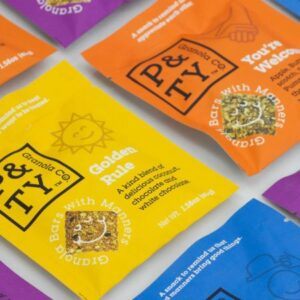
This category of mentions on packaging is used to target a specific audience. It is important that these mentions are not misleading for the consumer and that they correspond to the actual quality of the product. Here are some examples:
- Pure: term limited to certain products (e.g. 100% pure juice).
- Homemade or Made at home: the product is prepared in a non-industrial manner.
- Old-fashioned or Traditional: product made according to recorded ancient practices.
- Natural: unprocessed product, as found in its natural state.
- Local: the raw materials or production methods are linked to a specific geographical region.
- Lactose-free, sugar-free, gluten-free.
Complying with regulations is essential, but packaging should not be limited to informing: it must also sell. Discover how to use it as a real marketing lever.